AMFIU Business Consult

The Economy Is Sending Signals. Are You Reading Them?

Bank of Uganda, the Uganda Bureau of Statistics and the Ministry of Finance publish a great deal of information every quarter about the direction of the economy. That information describes the conditions in which our members farm, trade and repay. It tells us what is coming to our loan books before it arrives, where demand is about to shift, and which opportunities are opening while others close.

This issue reads those signals on behalf of the sector. It sets out six developments in the wider economy, what each one means for a SACCO, MFI or MDI, and how institutions can position themselves. Some of these signals are threats that need to be managed. Several of them are opportunities that our sector is better placed to capture than any bank in the country.

~Racheal Kobugabe, Team Lead, AMFIU Business Consult Ltd

Where the Sector Stands Today

Before reading the signals, it is worth stating clearly what our sector brings to the table. The Quarter 4 2025 Performance Monitoring Report consolidates returns from 104 institutions.

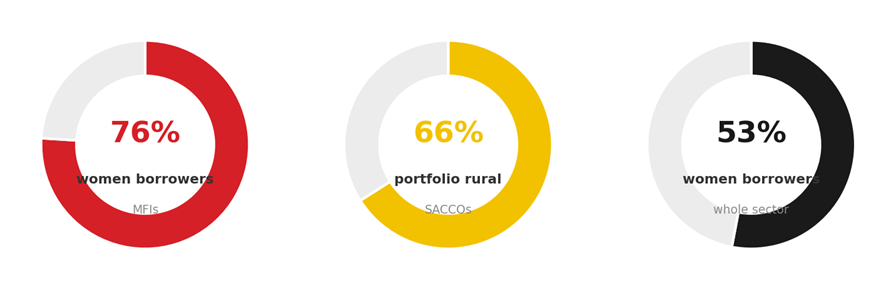
Depth of outreach by institutional category, Quarter 4 2025

These are the sector’s real strengths, and they matter for everything that follows. MFIs alone serve 695,107 borrowers, 76% of them women. SACCOs hold 66% of their portfolio in rural areas, the deepest rural footprint of any institutional category in Uganda. Across the sector, voluntary savings of UGX 1.75 trillion represent a stable, locally mobilized funding base.

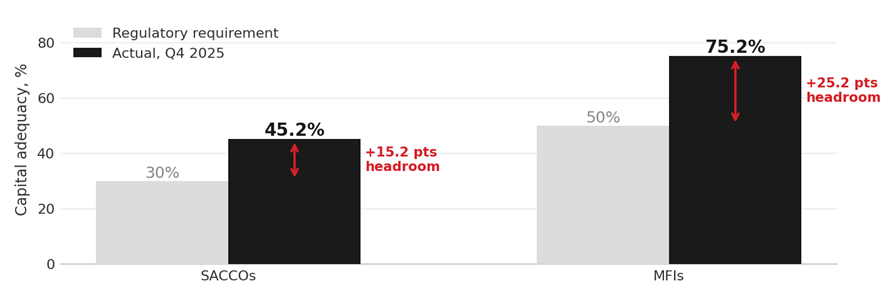
Capital is strong. SACCOs report capital adequacy of 45.2% against a 30% requirement, and MFIs 75.2% against 50%. The sector is not short of capital or of clients. What it needs is to read the environment accurately and deploy what it already holds.

Capital adequacy against regulatory requirement, Quarter 4 2025

One area does require honest attention.

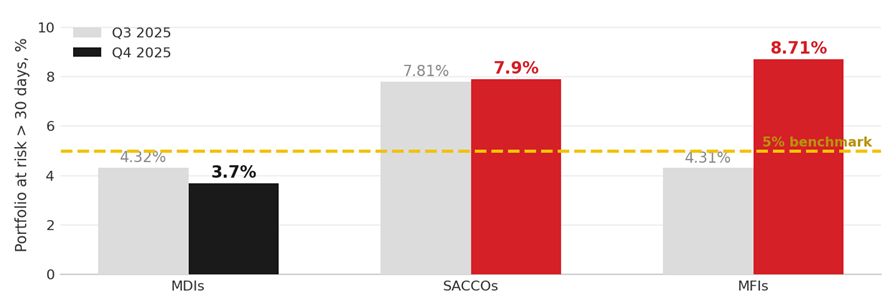
Portfolio at risk beyond 30 days rose in Quarter 4. MFIs moved from 4.31% to 8.71% in a single quarter, and SACCOs held at 7.9%, both above the 5% prudential benchmark. MDIs improved to 3.7%.

Sections that follow explain a substantial part of why this happened, and it has less to do with lending decisions than most boards assume. The cost pressures documented in Signal One were working through borrower businesses throughout the quarter. Institutions that read those pressures early can act before arrears appear.

PORTFOLIO AT RISK, QUARTER ON QUARTER

Portfolio at risk beyond 30 days, Q3 to Q4 2025, against the 5% benchmark

Six Signals from the Economy

Each signal below sets out what the national data shows, what it means in practice for a microfinance institution, and how to position for it.

SIGNAL 1: Your borrowers are being squeezed, and inflation figures hide it

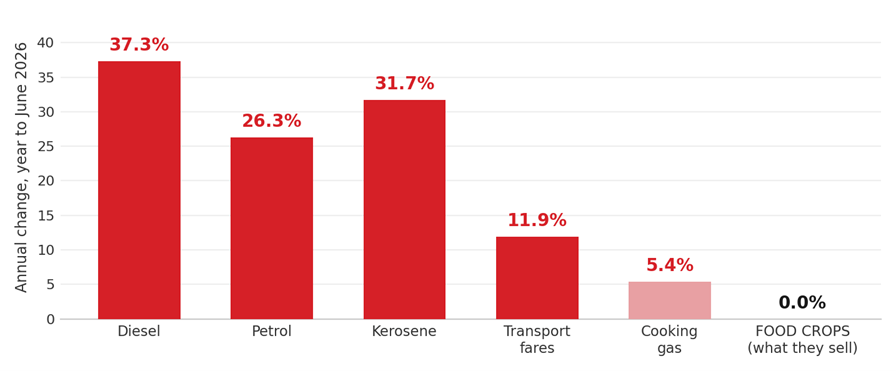
Uganda Bureau of Statistics reported headline inflation of 3.7% for the year to June 2026. Underneath that figure: diesel rose 37.3%, petrol 26.3%, kerosene 31.7% and passenger transport charges 11.9%. Over the same twelve months, food crop inflation was 0.0%, with matooke down 6.6% and dry beans down 7.2%.

A farmer or trader paying for land preparation, transport and input delivery faced cost increases of a quarter to a third over the year. The same borrower selling maize, beans or matooke received the same price as last year, or less. This is a margin squeeze, and it explains a good deal of the Quarter 4 movement in portfolio at risk. Arrears are the last symptom to appear, not the first.

THE OPPORTUNITY

Institutions that identify squeezed borrowers early can restructure before default, retaining both the client and the capital. A borrower approached in month two of difficulty usually recovers. The same borrower approached in month six usually does not. This is relationship lending, and it is precisely what our sector does better than any digital or branch-based competitor.

THE THREAT

Institutions that only discover the problem through a missed instalment will book the loss. Portfolios concentrated in maize, beans and matooke value chains carry materially more risk today than the 3.7% headline inflation figure suggests, and a portfolio priced on last year’s assumptions is underpriced for this year’s conditions.

How to position: Run a portfolio review by crop and by value chain this month, not at quarter end. Identify borrowers whose input costs rose while output prices did not, and contact them before the instalment falls due. Where transport is the binding cost, consider whether bulking and collective marketing through the group or cooperative can restore the margin.

What your borrowers pay for, against what they sell. Year to June 2026, Uganda Bureau of Statistics

SIGNAL 2:   Banks are lending less, and those borrowers are coming to you

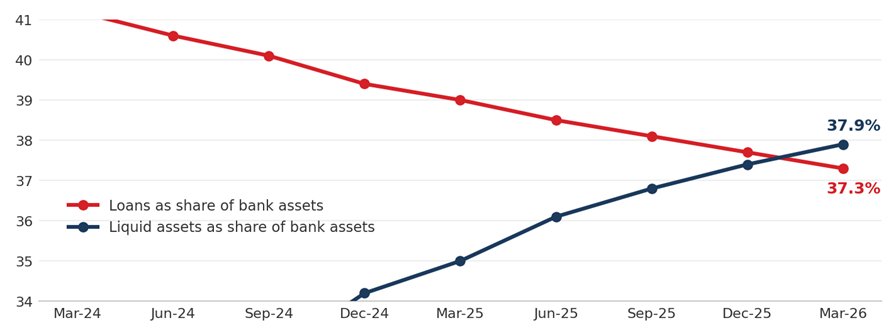
The Uganda Bankers’ Association reports that government securities and other investments rose from about 26% of Tier 1 bank assets in 2021 to approximately 31% in 2025. Whole-of-industry loans as a share of total assets fell from 41.2% in March 2024 to 37.3% in March 2026. Bank of Uganda’s Bank Lending Survey shows banks expect a net tightening of credit standards to enterprises of 32.0% for the quarter to September 2026, while easing to households.

Government is borrowing heavily to fund a fiscal deficit running toward 6.9% of GDP, and banks are lending to it because sovereign paper is liquid, well priced and requires no field officer. On a balance sheet of UGX 61.7 trillion, roughly UGX 2.4 trillion of lending capacity has moved away from private credit. The enterprises being declined do not stop needing money. They move down the chain.

THE OPPORTUNITY

A larger and better-quality pool of applicants is arriving at SACCO and MFI counters than these institutions have historically seen, and the tightening is specifically against enterprises, which is our sector’s core client. Institutions with sound appraisal capacity can select from this pool and grow their books with borrowers who would previously have banked elsewhere.

THE THREAT

An institution without proper appraisal will absorb rejects rather than capture opportunity. Some applicants were declined by a bank for good reason. Without a credit committee, written appraisal criteria and a credit reference bureau connection, an institution cannot tell a good borrower displaced by tightening from a poor borrower correctly refused.

How to position: Strengthen the appraisal function before pursuing the volume. Establish written credit criteria, a functioning credit committee and a credit reference bureau connection. Then market deliberately to displaced enterprise borrowers, particularly small agro-processors and traders, who are the segment banks are tightening against most sharply.

Whole-of-industry loans and liquid assets as a share of bank assets, March 2024 to March 2026

SIGNAL 3   Money is repricing upward, and member savings just became your best asset

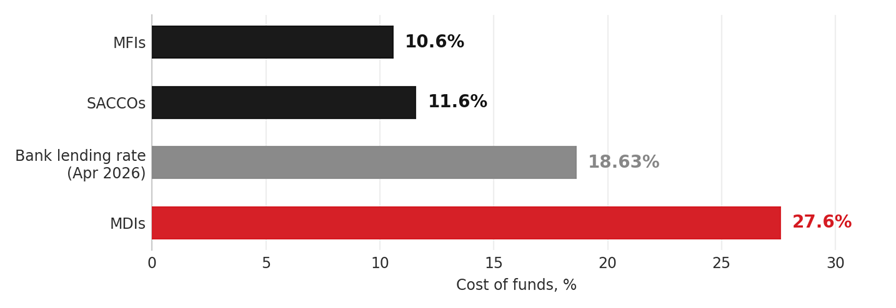
Bank of Uganda held the Central Bank Rate at 9.75% through 2026 but raised the Cash Reserve Requirement from 9.5% to 11.0% in March 2026. The weighted average shilling lending rate rose to 18.63% in the three months to April 2026, and 29.1% of banks expect rates to rise further in the quarter to September 2026.

A higher reserve requirement withdraws lendable liquidity from the banking system, and that repricing passes down the funding chain to every institution that borrows on the wholesale market. Within our own sector, the difference is already stark: MDIs report a cost of funds of 27.6%, against 11.6% for SACCOs and 10.6% for MFIs. The Bankers’ report notes that Tier 2 and 3 institutions have run loan-to-deposit ratios above 100% since 2022, peaking near 135% in 2023.

THE OPPORTUNITY

Institutions funded by member savings hold a structural advantage that is widening as wholesale money gets better. A SACCO funding its loan book at 11% while competitors reprice toward 18% and above can either protect its margin or price more competitively for good borrowers. Every shilling of member savings mobilized is a shilling not borrowed at a repricing rate.

THE THREAT

Institutions dependent on borrowed funds face margin compression at exactly the moment demand is rising. An institution lending more than it holds in deposits is exposed to the price of somebody else’s money, and that price is moving against it. Growth funded by borrowing in this environment can reduce profitability rather than increase it.

How to position: Make deposit mobilization the balance sheet priority for the coming year. Review savings products for competitiveness, use mobile channels to make saving convenient, and treat every borrower as a savings prospect. Where wholesale borrowing is unavoidable, negotiate and fix terms now rather than later in the cycle.

Cost of funds by institutional category, Q4 2025, against the commercial bank lending rate, April 2026

SIGNAL 4:  The banks are forecasting the same stress you are about to feel

Bank of Uganda’s Quarter Four FY2025/26 Bank Lending Survey found commercial banks reporting a net 48.0% expected increase in enterprise default rates and a net 37.8% expected increase in household default rates. Banks attribute this to rising fuel and input costs compressing margins, delayed salary payments and job losses, and geopolitical uncertainty.

These are the best-resourced credit risk departments in the country, looking at the same borrowers, in the same economy, and preparing for deterioration. This is not a comment on microfinance performance. It is a forward indicator available free of charge to any institution that reads it, several months ahead of the arrears it describes.

THE OPPORTUNITY

An institution that acts on this warning now can build provisions from current earnings rather than from a future shock, tighten appraisal on the most exposed segments, and enter the coming quarters prepared. Institutions that provision ahead of a downturn emerge from it able to lend, which is when the best opportunities appear.

THE THREAT

An institution that treats the current position as stable will provision late and from a weaker base. The categories most exposed are those lending to enterprises dependent on fuel and transport, and to salaried households facing delayed payment. Both are well represented in microfinance portfolios.

How to position: Review provisioning policy against this forecast at the next board meeting. Stress test the loan book against a repeat of the Quarter 4 movement in portfolio at risk and confirm the institution can absorb it. Tighten appraisal specifically on transport-dependent enterprises and on salary-backed lending where the employer is a delayed payer.

SIGNAL 5 :  UGX 2.26 trillion is going into agriculture, and you hold the last mile

The FY2026/27 national budget of UGX 84.39 trillion is themed on full monetisation of the economy through commercial agriculture. Agro-industrialisation received UGX 2.26 trillion, the largest allocation the sector has had, covering irrigation, inputs, post-harvest handling, storage, agro-processing and market access. A further UGX 2.4 trillion was announced for wealth creation programs, building on close to UGX 11 trillion already committed through the Parish Development Model. Oil revenues of UGX 1.4 trillion are expected for the first time.

Public money is being directed at exactly the value chains our sector already serves, and at the transition from subsistence to commercial production that our members are already making. But budget allocations reach households through delivery channels, and in rural Uganda those channels are SACCOs, cooperatives and VSLAs. Government funds production; it does not provide working capital season after season.

THE OPPORTUNITY

Institutions positioned in agricultural value chains stand to benefit twice: from members whose productivity rises through public investment in irrigation, inputs and extension, and from the working capital, input finance and post-harvest lending that public programmes do not cover. A farmer with irrigation and quality inputs is a materially better credit risk than the same farmer two years ago.

THE THREAT

Institutions without agricultural lending capability will watch this pass to others. Seasonal agricultural lending requires cash flow appraisal built around the crop calendar, not the salary month, and repayment schedules aligned to harvest. An institution applying monthly-instalment logic to a seasonal borrower will create arrears it then blames on the farmer.

How to position: Build or sharpen seasonal agricultural products now, ahead of the coming planting season. Align repayment to harvest and marketing rather than to calendar months. Position the institution as the working capital partner alongside public investment in production, and engage district production offices and cooperative unions on where program funds are landing.

SIGNAL 6   Distribution has moved to networks, and small consumer lending has gone

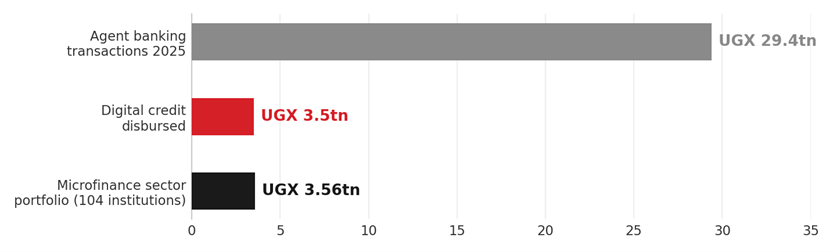
Bank of Uganda records mobile money digital credit disbursements of approximately UGX 3.5 trillion through more than 150 million transactions. Shared agent banking transaction values rose 76.1%, from UGX 16.7 trillion in 2024 to UGX 29.4 trillion in 2025, with agents up 49.1% to 22,793. Mobile money account ownership reached 68% of adults in 2024, while bank account ownership fell to 26%.

Financial services have moved decisively from premises to networks. Small, short, instant consumer loans are now a digital product, and that competition will not be won back on speed. At the same time, the whole population is now reachable through channels that need no branch.

THE OPPORTUNITY

What digital lenders cannot do is assess a seasonal agricultural cash flow, value a standing crop, restructure around a failed harvest or hold a relationship through a bad season. That is our sector’s defensible ground and it is where the margin is. Digital channels can also be used for collection and savings mobilisation, cutting cost per transaction without surrendering the credit relationship.

THE THREAT

Institutions competing for small consumer loans on speed will lose, and will lose money doing it. The deeper risk is the account relationship: members may borrow from a SACCO while holding their transacting account elsewhere, which surrenders savings, cross-selling, credit history and loyalty to another provider.

Annual transaction and disbursement values against the microfinance sector portfolio

How to position: Concede small instant consumer lending and defend agricultural, enterprise and seasonal lending where judgement is required. Use mobile and agent channels for repayment collection and savings, not for origination. Above all, give members a reason to hold a live, transacting account with the institution, because the account relationship carries everything else.

One Regulatory Deadline That Cannot Wait

Under the Microfinance Deposit-Taking Institutions (Registered Societies) Regulations 2023, SACCOs exceeding two thresholds must transition to Bank of Uganda supervision. The thresholds are voluntary savings above UGX 1.5 billion and institutional capital above UGX 500 million. Bank of Uganda has identified approximately 90 SACCOs as meeting this definition.

The original compliance date of 31 March 2026 was extended to 30 September 2026 to allow for stakeholder engagement and to give SACCOs time to prepare licensing documentation. At the date of this brief, that leaves approximately two months.

If your SACCO holds voluntary savings above UGX 1.5 billion, treat this as a board item at the next sitting.

Bank of Uganda supervision requires audited accounts, prudential returns, governance structures, capital adequacy computation and reporting systems of a standard above what Tier 4 reporting has historically demanded. Preparation done properly takes weeks.

The regulator has stated that regulated financial service providers, including commercial banks, should continue serving eligible SACCOs during the grace period. That protection is tied to the grace period.

Transition should be read as an opportunity rather than a burden. A SACCO under Bank of Uganda supervision carries materially greater credibility with commercial banks, development partners and impact funders, and gains access to funding lines that unsupervised institutions cannot reach.

The partnership terms are already published

Banks are actively seeking SACCO and VSLA partnerships, and the terms are known. Under the EAMIAT project in the Sebei sub-region, Stanbic Bank has partnered with 84 groups, offering free SACCO account opening and unsecured facilities of up to UGX 400 million. The stated qualifying conditions are that the SACCO is organised, maintains proper books of account, and has no governance challenges.

Those are not capital requirements or scale requirements. They are systems requirements, and they are within reach of most institutions reading this brief within one or two reporting cycles. An institution that can answer yes to the three questions below is fundable today and should be approaching a bank.

1. Are our books of account current to within one month, and were our last accounts audited without qualification?

2.Does our board meet on schedule, keep minutes, and is there any unresolved dispute over management or signatories?

3.Can we produce a portfolio ageing report, a member register and a capital position statement on request?

Positioning for the Next Four Quarters

Taken together, the six signals point in a consistent direction. Credit demand is rising while formal bank supply tightens. Money is becoming more expensive for institutions that borrow it and cheaper, in relative terms, for those that mobilise it. Public investment is flowing into the agricultural value chains our sector already serves. And distribution has moved to networks that our institutions can use rather than resist.

The summary below sets out where to concentrate effort.

Priority

Why now

First step

Deposit mobilisation

Wholesale funding is repricing upward; member savings are the cheapest and most stable source available

Review savings product terms and set a mobilization target for the year

Credit appraisal capacity

Better-quality borrowers are arriving as banks tighten, mixed with genuine declines

Establish written criteria, a credit committee and a credit reference bureau connection

Seasonal agricultural products

UGX 2.26 trillion of public investment is entering the value chains you serve

Align repayment schedules to harvest and marketing rather than calendar months

Early arrears management

Cost pressures are working through borrower businesses now, ahead of arrears

Portfolio review by crop and value chain; contact affected borrowers before due dates

Provisioning review

Banks forecast a net 48.0% rise in enterprise defaults

Stress test against a repeat of the Quarter 4 movement in portfolio at risk

Bank of Uganda licensing

Deadline of 30 September 2026 for SACCOs above the thresholds

Assign a named person to documentation at the next board meeting

Women’s participation

Sector share fell from 54 to 53%; SACCOs report only 32%

Address cost, collateral and distance together, not separately

ESG measurement

Only 7% of reporting institutions submitted ESG indicators

Begin measuring now to qualify for climate and impact capital later

The position in one paragraph

Uganda’s microfinance sector holds strong capital, the deepest rural footprint in the country, 1.46 million borrowers and UGX 1.75 trillion of locally mobilised savings. The economy is moving in a direction that favours institutions with exactly those characteristics: close to the client, funded locally, able to lend where judgement matters more than automation.

What determines which institutions capture this is not size. It is whether the institution can read its own portfolio in time to act, appraise a borrower it has not seen before, and fund growth from savings rather than from borrowing that is getting dearer.

Those are all buildable capabilities, and the window in which to build them is the next four quarters

How AMFIU Business Consult Ltd Can Support

AMFIU Business Consult Ltd is the commercial consulting arm of the Association of Microfinance Institutions of Uganda. The priorities set out above are the work we do with institutions across Uganda and the wider East African region:

1.Portfolio quality diagnostics, including ageing analysis, arrears cause analysis by crop and value chain, and provisioning review.

2.Seasonal agricultural product design, including cash flow appraisal built around the crop calendar and harvest-aligned repayment schedules.

3.Credit appraisal systems, credit committee structures and written appraisal criteria for institutions receiving displaced enterprise borrowers.

3.Deposit mobilisation and funding strategy for institutions seeking to reduce reliance on wholesale borrowing.

4.Bank of Uganda licensing preparation for SACCOs approaching the 30 September 2026 deadline, covering documentation, prudential returns and capital computation.

5.Governance and record-keeping strengthening aimed at the qualifying conditions for bank partnership and funder due diligence.

6.ESG measurement and reporting readiness aligned to Bank of Uganda’s 2025 guidance on the IFRS S1 and S2 standards.

7.Financial literacy and capacity building for members, cooperatives, VSLAs and farmer groups, delivered in the field and through Training of Trainers.

Where to start

Institutions concerned about the Quarter 4 movement in portfolio at risk should begin with a portfolio diagnostic. It takes days rather than months, and it will show whether the deterioration is concentrated in a value chain, a branch, a product or a season. In most institutions we work with it is concentrated, and once located it is correctable.

SACCOs approaching the 30 September 2026 licensing deadline should make contact this month.

Contact the team on the details below to arrange an initial discussion. There is no charge for a first conversation about where your institution stands against the signals in this brief.